Mini Cart

What Is a Shipping Bill?

If you work in international trade, then knowing what is a shipping bill, is crucial. Whether you are a beginner in exporting, or an old hand, this document is crucial for every export transaction in India. what is a shipping bill? It is a legal document that an exporter, or an exporters customer broker, or india shipping attorney, submits to the Indian Customs before the shipment can leave the country. No shipping documents are contraband in India.

Understanding what is a shipping bill, helps exporters to confidently and accurately control the export cycle. The Shipping bill meaning is the formal statement an exporter submits to customs, detailing the goods to be exported, their quantity, monetary value, country of destination, and duties, if any, are payable, or if any are to be exempted. The shipping bill meaning is also more than just a statement. It is a document that is an integral piece to ensuring your export cargo is cleared with the customs, and that you can claim a duty drawback and a GST refund.

What Is a Shipping Bill in Export?

The shipping bill is a document that verifies the entire export procedure. What is a shipping bill in simple terminology? It is your legal authorization document from the Indian Customs Department to clear goods across the frontier. No Let Export Order (LEO) is issued what is a shipping bill, and your cargo cannot be given to the transporter. Every genuine exporter should clearly understand what is a shipping bill is, before embarking on their first export consignment. Mistakes on the shipping bill have serious consequences, such as regulated delays and denial of refund claims.

What is shipping bill in export includes defining and clarifying the most critical aspects for your consignment. Every exporter should understand what is shipping bill in export because mistakes will cost lots of time trying to sort out the shipping and mistakes will also affect your claims for refunds. Here is what this document controls for every export:

  • It controls the answer to and the question of whether one is entitled to a drawback of duties or a refund of the IGST from the Indian Customs authorities.
  • It provides a capture of the correct HS Code classification of the exported goods for the purpose of tariffs and compliance.
  • It provides a record of the FOB value of the shipment for the purpose of statistical reporting as well as the calculation of the duties.
  • It provides a mention of the port of loading and port of destination as well as the shipping line’s name that will handle the cargo.
  • It offers a linkage of the IEC number and GSTIN to the shipment for the purpose of processing post-export benefits.

Categories of shipping bills

There are a number of types of shipping bills based on the nature of the export and the duty benefits claimed. Familiarity with these types of shipping bills pick the right one and avoid rejection at the customs. The right choice can avoid duty refund delays or disputes at the custom. Always consult your customs agent prior to filing.For more details on essential export documents like the Certificate of Origin.

Five main types include the Dutiable Shipping Bill, used when export duty applies; the Duty-Free Shipping Bill, submitted when there is no export duty; the Drawback Shipping Bill, submitted to claim duty drawback; the DEPB Shipping Bill, used in the Duty Entitlement Passbook Scheme; and the Ex-Bond Shipping Bill, submitted when goods are exported from a bonded warehouse. Each type serves a specific purpose and is required to be chosen based on your export category and eligibility.

Shipping Bill Format

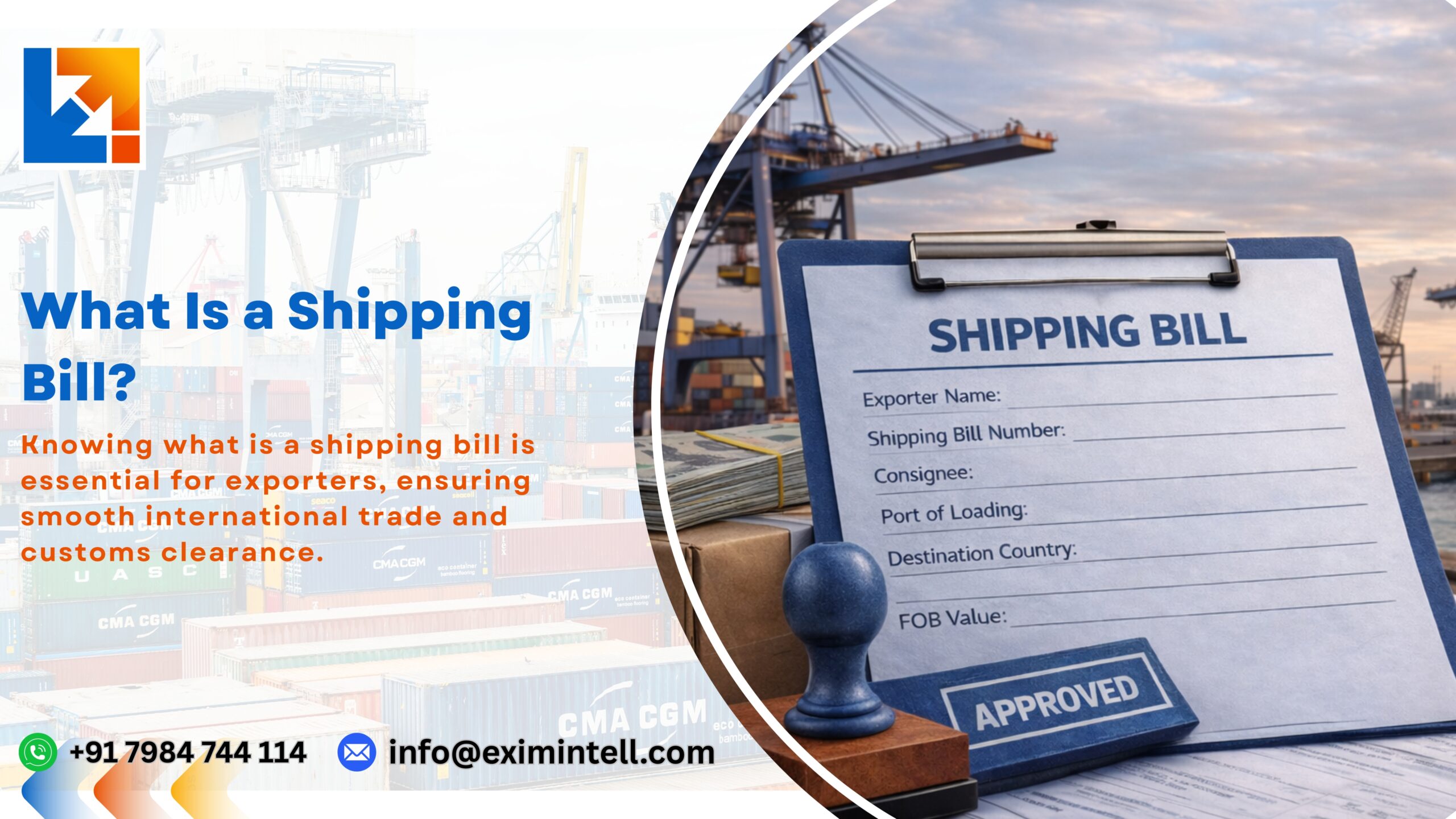
The shipping bill format, as standardized in the Indian Customs ICEGATE system, is to be filed digitally before the shipments leave from the port. The shipping bill format captures all relevant information and each exporter is required to do the following before submission:

  • The name of the exporter, IEC number, and GSTIN must match with the ICEGATE portal.
  • Name of Consignee, country of destination, and complete address for the shipment must match with export invoice
  • To avoid customs interrogation / penalty, HS Code and FOB value of the goods must be mentioned.
  • Port of loading, name of the shipping line and Vessel are to be updated at the time of filing the bill.
  • To expedite post export benefits, the Duty Drawback Code or claims of IGST refunds should be clearly mentioned.

The shipping bill format has, to a large extent, been digitized under SWIFT in India, thus expediting and increasing transparency with respect to exporters. The filing of shipping bills requires a declaration and a digital signature of the exporter or his/her authorized Customs House Agent. Any mismatch of the particulars may lead to Customs queries or delays in the issuance of the Let Export Order.

Shipping Bill Number and Shipping Bill Enquiry

After your documents have been filed and processed, customs assigns your consignment a distinct shipping bill number. This shipping bill number will be your most important reference for communication concerning that shipment, including GST refund claim communications, duty drawback application communications, and communications with your freight forwarder or shipping line. Your shipping bill number will be required for communications during the post-export compliance process, so keep it for your records. For a deeper look at the Import-Export Industry and how you can tap into the opportunities it provides.

A shipping bill enquiry provides exporters with the ability to check the status of their documents in real time on the ICEGATE portal. Using shipping bill enquiry on ICEGATE, you can do the following:

  • Confirm whether or not your shipping bill has been filed and accepted by Indian Customs
  • Find out if a Let Export Order has been issued for your shipment at the port
  • Determine if there are any auxiliary queries or examination orders issued by the customs officer
  • Identify the current status of your export clearance, from filing to the issuance of the final LEO
  • Check whether there are any pending duties to be refunded or tied to the shipping bill number

Performing regular shipping bill enquiry will help you stay updated on the status of your shipment and will help to prevent customs compliance issues and port delays.

Frequently Asked Questions

Q1. What is a shipping bill and who files it?
A shipping bill is a required customs document for exporting goods from India, and it is filed by the exporter or their authorized Customs House Agent via the ICEGATE portal before the shipment leaves.

Q2. What types of shipping bills are there?
The types of shipping bills include dutiable, duty free, drawback, DEPB, and ex-bond. These are differentiated based on the nature of the exports and the duty benefits.

Q3. How do I enquire about shipping bills online?
To know the status of your shipping bill, go to ICEGATE’s official website. There, you will see a shipping bill status tracker, where you will enter your shipping bill number, shipping bill date, and the port of export.

Conclusion


Shipping what is a shipping bill compliance and clear documentation, and are the first step in facilitating profitable exports from India. Submitting an accurate shipping bill format, tracking your consignment through the shipping bill enquiry, and keeping your documents clear and accurate, all ensures you stay on the right side of the law. These will help you to maximize your exports and receive any drawback, GST refunds and your LEO on time. The answer to the question, what is a shipping bill will shape your exports. If you want guidance with documentation, sourcing, or shipping procedures, you can always Contact Us to get expert assistance before starting your export journey.


Continue Reading

When businesses look to expand, going global is a great opportunity. But exporting can become very costly very quickly. Export financing is a solution. New businesses need to learn this so they can keep their operations running, their cash flow steady, and reduce financial risks that come with exporting.

This is a breakdown of what export financing is, the different types, and how businesses can use it to expand to global markets.

What is Export Financing?

Export financing is the collection of services that offer financial assistance to exporters to help support the production, shipment, and selling of goods to international clients. It bridges the cash flow gap created when orders are shipped to overseas clients and payment is received.

To put it simply, exporters have to deal with international trade cycles that are much longer than they are accustomed to, so they need to use financing methods to help cover operational costs.

Financing for export allows traders to complete large orders, gives them a chance to expand into international markets, and helps them stay competitive in international commerce. It is important to remember that with financing come trade documents. For example, exporters must obtain a Certificate of Origin, which is a document that states the manufacturer’s country of origin and is necessary for customs clearance.

Why Export Financing is Important for Export Businesses

Exporting requires a lot of money. Exporters have to pay for everything from raw materials to manufacturing, packaging, and transport to the costs of the entire logistics chain. Many businesses do not have the ability to fund these expense counters without proper financing.

The following is a list of significant considerations that export financiers consider when granting financing.

  • Cash Flow Improvement: Exporters receive financial support, including cash flow assistance, prior to or following the shipment of goods.
  • Large Order Support: Exporters can meet international customer demand without stretching the cash flow.
  • Payment Risk Reduction: Export financiers mitigate payment delay risk.
  • Market Expansion: Exporters can expand their businesses without the risk of cash flow drying up.

The best export finance solutions are those that allow businesses to handle the international payment cycle with the smoothest operation. At the same time, exporters must be able to manage their import and export documentation for compliance with international trade laws.

Types of Export Financing Available

Export financing can be split into multiple categories. Most of these categories focus on determining at what stage of the export process the financing occurs. Different categories offer exporters different financing options.

Pre-Shipment Export Financing

This type of financing occurs before exporters ship the goods and sell them to international customers. Financing before shipping helps exporters/direct exporters cover the production costs and prepare the necessary operational components.

Export financing prior to shipping includes a variety of operational components that aid in preparation:

  • An acquisition of raw materials
  • The production of necessary goods
  • The preparation of the goods through necessary packaging and labeling
  • The movement of the goods to port

This kind of financing alleviates the financial burden on exporters and/or direct exporters.

Post-Shipment Export Financing

This type of financing occurs after the goods are exported and shipped. Moreover, after the payment has been received by the international customer. This type of financing is necessary to ensure that exporters/direct exporters have cash available to cover day-to-day operational costs. This is because cash received from international customers can take weeks or even months to receive.

There are several benefits of export financing after shipping goods, including:

  • Immediate access to finances after the shipment of goods.
  • An increase in cash turnover from customers.
  • An improvement in the operational management of finances.

This type of financing is especially critical in cases where the exporter/direct exporter grants credit to the international customer.

Export Credit Finance

Export credit finance is another vital funding option for exporters, as it provides protection against payment risks involved in international trade. Banks and Export Credit Agencies (ECAs) offer export credit facilities to exporters and provide protection against buyer default and buyer payment delays.

Export credit financing offers protection to exporters by:

  • Offering credit insurance for international trade
  • Minimizing the exposure to risks for overseas buyers
  • Offering protection against payment risks involved in international trade

This type of financing is commonly used in international trade transactions.

Common Export Finance Solutions for Businesses

Depending on the size of the business, the volume of exports, and the cash flow needs of the business, there are a variety of export financing alternatives available to the business. Banks, financial institutions, and government-supported export agencies provide these alternatives.

Bank-Based Export Finance

A significant amount of export financing available to businesses is provided by banks. Banks have designed a variety of trade finance products to assist exporters and provide the necessary financing for export.

Examples of export financing service providers are:

  • Working capital loans to exporters
  • International sales invoice financing
  • Financing letters of credit
  • Export bill discounting

These financial instruments assist exporters in efficiently managing international transactions.

Government Export Financing Schemes

To promote international trade, many governments have established programs for the promotion of exports and export financing. These programs offer financial support, guarantees of credit, and incentives to exporters.

Government-backed Export Financing Programs Include:

  • Export credit guarantee schemes
  • Interest subsidies for exporters
  • Financial support for small and medium exporters
  • Trade promotion financing

Such programs assist exporters by reducing financial risks and allowing them to widen their scope for international marketing.

How New Exporters Can Apply for Export Financing

New exporters must prepare some documents and a financial strategy to have a successful chance at getting financing for their exports. Export financing is a function of three factors: the presiding rule of a financial institution, the business documents of the exporter, and the existing financial transactions related to the export order.

Export financing applications generally include the following:

  • Registration of the export business
  • Creation of a bank account for export transactions
  • Submission of international export contracts
  • Submission of business financial records
  • Submission of the company profile

The export financing procedure is easier, in most cases, with the services of a professional import-export consultant.

Documents Required for Export Financing

Financial institutions generally seek the following documents for export financing:

  • Export purchase orders or contracts
  • Business registration certificates
  • Import Export Code (IEC)
  • Financial statements and bank records
  • Shipping and export documentation

Proper documentation can speed up the financing approval.

Challenges in Export Financing and How to Overcome Them

Though export financing has its advantages, several challenges may arise when securing funding for first-time exporters.

Some obstacles are:

  • A short financial history for new businesses
  • A high volume of documentation is required
  • Currency fluctuations in markets overseas
  • Payments are late from international buyers

Exporters can overcome challenges by improving their financial documentation and transparency and selecting trustworthy international buyers.

Tips for Managing Export Finance Efficiently

Exporters can employ the following strategies for greater financial stability:

  • Financing of exports by reputable banks
  • Each method of international payment is secure (use of letters of credit is recommended)
  • Good documentation and financial records
  • Spread your risk by diversifying your export markets

Exporters can achieve financial stability in international trade through sound export finance management.

Role of Export Consultants in Export Financing

Consultants on exports and specialists on trade aid in the understanding of the intricacies of financing international trade. Professional assistance is particularly valuable to novice exporters to simplify the financing and export transaction management processes.

Export consultants help businesses with:

  • Finding viable options for export financing
  • Preparing the necessary export documents
  • Linking exporters to banks and other financial institutions
  • Advising on export and other global trade laws

Partnering with seasoned export consultants can help businesses enhance their export-related risks and opportunities.

Conclusion

Export financing is a vital resource for the production, transport, and sale of goods to new international markets for new businesses entering foreign marketplaces. Different export finance solutions available to exporters allow them to optimize the working capital and increase the scope of their international activities.

In global trade, exporters can remain confident with the right financing approach and the appropriate planning, especially with export credit finance and post- and pre-shipment financing. Competitiveness in the international marketplace is achievable through the right export tools and assistance.

Continue Reading

A major challenge in international trade is securing payment from buyers and sellers located on different sides of the globe. One way to address this issue is through a letter of credit in export. It includes a guarantee from the buyer’s bank, meaning payment is secured to the seller once they meet the conditions of the letter. This letter of credit in export decreases the risks of international transactions, plus it gives both parties confidence in their agreement.

A letter of credit in export is issued by the buyer’s bank. It is a guarantee that the seller will be paid once they meet the terms of the agreement. The LC full form in export is believed to be The Letter of Credit. It secures payment for the buyer and ensures the seller is paid only after the agreement’s terms are fulfilled. This form of credit improves the seller’s payment risk and strengthens the confidence of the trading partners.

What is Letter of Credit in Export?

To export means to deliver goods to another country, so letter of credit in export are committed promises of the buyer’s bank to pay the seller after the seller completes the requirements specified in the terms of the letter of credit. In international trade transactions, letters of credit act as a financial guarantee. As long as the seller meets the buyer’s terms, they will be paid. A guarantee of letter of credit meaning in export that the buyer will incur an obligation to pay once the goods are shipped. There are specific details regarding what the buyer is obligated to pay, like the time of the shipment, the quality of the goods, and the quantity of the goods. In global commerce, the meaning of a letter of credit meaning in export is of great importance, as they alleviate the worries of payment not being made and not receiving the goods.

The letter of credit in export offers benefits as a means of alleviating the concerns of new trading partners. Since a bank is involved as a third party, the buyer and seller can both have increased confidence in the deal. LC full form in export assures both parties in an international transaction, which is why both parties in international trade want to know what is letter of credit in export of credit is. It offers protection and alleviates the concerns and financial exposure of both parties involved.

Procedure for Letter of Credit in Export

Steps in a procedure for letter of credit in exporting involve the buyer and seller in the transaction. When the buyer and seller agree on the sale, the buyer requests a letter of credit from their bank, whose conditions must be met before the seller is paid. The bank assesses the buyer’s credit before forwarding the letter of credit to the seller’s bank. This method of payment ensures a smooth, transparent process, especially when dealing with new or international business partners. For more details on essential export documents like the Certificate of Origin.

After the seller receives the letter of credit, they ship the goods per the contract. Next, the seller presents their bank with the necessary documentation, including the bill of lading and commercial invoice. The seller’s bank checks and then forwards the documents to the buyer’s bank. If the buyer’s bank encounters no issues what is letter of credit in export, then the bank pays the seller. This process complies with the letter of credit process, ensuring the seller is paid and the buyer is protected. Exporting with a letter of credit process helps businesses involved in international trade understand credit’s role, offering payment security.

Key Advantages of Using a Letter of Credit in Export

  • Payment Security: A letter of credit in export protects the seller’s payment, assuring that they will be compensated once the terms are satisfied.
  • Trust Building: Letters of credit encourage seller and buyer confidence since banks, as third parties, are involved.
  • Reduced Risk: Letters of credit in exports eliminate the risk of loss of trade because they cover both the seller and the buyer from the financial loss, the fraud, and other trade-related risks.
  • Flexible Payment Terms: Each party in the deal can choose the type of letters of credit they prefer. This includes sight LCs or time LCs, allowing them to customize their options.
  • Global Trade Simplification: International payment guarantees in a trade transaction provide a secured payment option, which simplifies trade as a payment option.

How the Letter of Credit Process Works

The letter of credit process provides security for both parties, the seller and the buyer. The seller receives the presumption of payment for the goods from their bank to the buyer and his bank. The seller also gains a form of assurance of payment once he meets his obligations (like sending the goods and presenting the required documents). For a deeper look at the Import-Export Industry and how you can tap into the opportunities it provides.

Here are the simple steps that make up the letter of credit process:

  • The buyer and seller agree on the terms of the sale that will be in the LC.
  • The buyer’s bank applies for an LC.
  • Once the documents are received by the seller’s bank, the seller banks the LC to the seller.
  • The seller ships the merchandise and gives the documents to his/her bank.
  • The seller’s bank verifies the documents and forwards them to the buyer’s bank.
  • The buyer’s bank sends the payment to the seller if everything is in order.

This simple process protects both sides during the deal and makes sure that the seller is paid as soon as they meet the terms of the letter of credit.

Frequently Asked Questions (FAQ)

Q1: What is the difference between a bank guarantee and a letter of credit for exports?
A letter of credit in exports means that the seller will receive payment as long as the terms of the agreement are met.In contrast, a bank guarantee simply means the seller is guaranteed to do his part of the contract, but payment for the goods is not guaranteed. The difference here is that a letter of credit guarantees payment, while a bank guarantee guarantees performance.

Q2: What documents are required for a letter of credit in export?

To process a letter of credit in export, there are several documents required, such as a commercial invoice, bill of lading, certificate of origin, packing list, and insurance documents, among other documents. Payment of the letter of credit is determined by the bank after reviewing the terms of the letter of credit. Payment is made to the bank.

Q3: What is the average time it takes to complete the process of a letter of credit when exporting?
A letter of credit can take from 7 to 15 days to complete the payment processing cycle after the export of goods to buyers and the submission of export documentation, depending on the type of letter of credit and the speed of processing of the banks involved.

Conclusion

A letter of credit in export is a terrific way to protect both the buyer and the seller when they trade internationally. In this situation, the seller knows he will get paid as long as he follows the terms of the transaction, which means he doesn’t have to worry about not getting paid. The buyer knows he won’t have to pay for the items until he gets the exact procedure for letter of credit. Exporters and importers can do safe and easy business with others across borders by following the letter of credit process and making sure all terms are followed. Using a letter of credit in export can give you the protection and trust you need to do business across borders with ease, whether you’re an experienced exporter or just beginning out in global trade. If you want guidance with documentation, sourcing, or shipping procedures, you can always Contact Us to get expert assistance before starting your export journey.

Continue Reading

Sugar is one of the many important products from India’s booming agricultural industry. Therefore, the sugar export from India has become one of the many industries that has captured the interest of many budding entrepreneurs and traders as a result of India’s high production capacity and competitive pricing. Indian sugar is a fundamental element of many foods around the world, and because of that, it has become one of the many products that create a market for international trade.

Sugar export from India offers many business opportunities. For first-timers, it is crucial to grasp the market need, the relevant documentation, the procurement and logistics involved. Reliably educated business partners and shrewd exporters can create a lasting, profitable business.

Overview of the Indian Sugar Industry

Over the years, India has been one of the largest producers of sugar due to its vast sugarcane cultivation. India has a very strong and well-structured sugar milling industry, which provides the india sugar export with the ability to mill and export sugar on a yearly basis.

The india sugar market is in a constant state of growth and therefore allows sugar exporter to create a constant supply contract. A beginner in sugar exporting can be successful through quality sugar procurement and adherence to the necessary legal frameworks.

Why Start a Sugar Export Business?

International Sugar trade has been benefiting sugar businesses all over the world in which country is the largest producer of sugar is a daily necessity. With India being the top producer of sugar in the world, the sugar production yields excellent trade opportunities. India being a top producer is beneficial to sugar export from India. India exports many agricultural products besides sugar. For example, businesses involved in Coconut Export from India also follow similar documentation, sourcing, and shipping procedures, making it easier for exporters to diversify into multiple commodities.

Key benefits include:

  • High demand in the food industry

  • Availability of sugar in bulk

  • International prices of sugar are good.

  • Growing network of suppliers of sugar

  • Repeat business from long-term buyers

The steady export of sugar makes this business less risky compared to seasonal commodities.

Types of Sugar Exported

Different countries require different grades of sugar depending on their industry needs. Exporters must understand quality standards before shipping products.

Indian Exporters provide raw sugar, refined white sugar, ICUMSA grades, white plantation sugar, and others. High-quality sugar that is consistent is obtained from reliable suppliers of sugar.

Step-by-Step Process: How to Export Sugar from India

Before starting the process, it is important to know how to export sugar from India which includes registration, answering buyers’ questions, and coordinating dispatch. Understanding global trade trends is essential for success. Entrepreneurs entering the Import-Export Industry often begin with high-demand commodities like sugar because they offer stable international demand and repeat buyers.

Business Setup

  • Get the Import-Export Code
  • Get business registration done
  • Set Up an International Payment Account

Finding Buyers

  • Connect on B2B (Business-to-Business)
  • Send product price quotations
  • Set payment terms

Shipment Process

  • Confirm packaging standards
  • Book shipping container
  • Complete customs clearance

After your first shipment, learning how to export sugar from India becomes much easier through practical experience.

Documents Required

The export of sugar is a highly document-intensive process and delays can be caused due to the lack of properly prepared documents. Completing paperwork ahead of time can streamline the customs process.

Important documents include the commercial invoice, packing list, certificate of origin, and inspection certificate. Every professional sugar exporter maintains accurate records to build trust with buyers.

Countries Importing Indian Sugar

The  India sugar export to many parts of the world because of its affordable price and ready availability. The incremental increase in sugar exports from India to various global markets indicates its growing presence worldwide.

Major importing regions include the Middle East, Asia, and African countries. The continuous demand makes sugar export from India suitable for long-term international trade relationships.

Cost and Profit Margin

Profit depends on procurement price and shipping cost. Monitoring trends in the india sugar market helps exporters decide the right time to sell.

Main cost factors:

  • Purchase price from mills

  • Packaging and handling

  • Freight and logistics

  • Insurance and paperwork

As a result of export of sugar in bulk quantities, even the smallest margins may lead to high profits.

Challenges in Sugar Export

Every trade business has risks, and sugar export from India is no exception. Exporters may face price fluctuations and shipping delays.

An experienced sugar exporter manages risks by signing contracts, securing advance payments, and monitoring global price trends carefully.

Tips for Beginners

Entering international trade requires practical planning and careful execution.

Helpful beginner tips:

  • Verify buyers before deals

  • Maintain quality consistency

  • Track global market prices

  • Work with experienced logistics agents

  • Learn practically how to export sugar from India through small orders

These steps help build a strong understanding of the India sugar market and reduce financial risk.

Future Scope

Sugar is a vital ingredient in many processed foods, and as simple foods are becoming more popular, the demand for sugar continues to grow. The capacity for India sugar export is also expected to fuel the rise in sugar export from India. For new entrepreneurs, there is long-term opportunity for prospects in the sugar exportation industry. Many novices who are looking to research which country is the largest producer of sugar will find India as one of the top sugar producers in the world. This expansion ensures long-term opportunities in sugar export from India for new entrepreneurs.

Frequently Asked Questions

Which country is the largest producer of sugar?
Brazil is the largest producer of sugar, while India is in second place.

Is the sugar export business profitable?
Yes, there is a consistent and large demand for this type of business.

What is the first step to exporting?
The first steps to export include obtaining your import/export code and export documentation.

Conclusion

For entrepreneurs entering the new world of the international trade system, sugar export from India is one of the best first businesses you could start. There is reliable demand, strong supply networks, and an expanding market. With the right documentation and a thorough understanding of sourcing and managing your buyers, you will be able to grow an export business that is both sustainable and profitable.If you want guidance with documentation, sourcing, or shipping procedures, you can always Contact Us to get expert assistance before starting your export journey.

Continue Reading

India has always been a gold market, not only for its cultural importance but also for its global sourcing of gold markets. In the past couple of years, India’s gold export have become a dominant player in the global jewelry industry. Indian traders are sending gold products of the highest quality to customers on every continent, bolstering India’s position in global commerce. With organized trading systems, Gold export from India have also been global jewelry trendsetters.

Overview of Gold Export From India

When examining gold exports from India, one can assess both the primary gold and finished jewelry products. While primary gold is a great contributor to the international supply chain, finished jewelry products are more sophisticated and increase the value of the gold exported through design and craftsmanship. Over the years, India has developed its export of gold from India into a structured and compliant industry.

Gold exports include:

  • Raw and semi-processed gold
  • Finished gold jewelry for retail and wholesale markets
  • Customized jewelry for specific international markets

Proper documentation is a vital requirement for international trade. For gold exporters, a Certificate of Origin is critical because it verifies that the gold is exported from India. This document helps exporters:

  • Establish product authenticity
  • Access trade preferences
  • Build trust for repeat business

These points help increase gold exports from India.

Export of Gold From India: Market Trends and Global Demand

Global Demand Trends Fueling Gold Export From India

Jewelry is in high demand because of its potential financial return and cultural importance. This is why the export of gold from India is in demand in various regions, including:

  • Middle Eastern countries that have a traditional preference for gold
  • European countries that prefer designer or artisanal quality
  • North American countries that prefer high-end quality

Gold export from India is growing in volume and expanding its markets.

Gold Jewellery Export From India

The gold jewellery export from India has become one of the most important components of India’s total export value. The combination of Indian jewelry’s modern designs and traditions is what Indian jewelry is known for and is one of the reasons why Indian jewelry can appeal to different international markets.

Rapidly expanding demand can be attributed to:

  • Consistently high gold purity and quality
  • A diversified selection of gold jewelry design at various price levels
  • Manufacturers’ skill to make jewelry that satisfies specific market tastes

As export volumes increase, the need for effective documentation and compliance will only grow. The Import Export Document Checklist for Gold Export helps exporters:

  • Manage shipping and customs documentation
  • Avoid regulatory delays
  • Strengthen the export of gold from India

Role of Gold Manufacturers in India

A large part of the success of India’s gold jewelry export also rests with India’s gold manufacturers. Gold manufacturers in India mirror the skill of the designer and the technology of modern manufacturing.

Their contribution includes:

  • Produce consistent quality
  • Have the ability to manufacture in large quantities
  • Are able to fulfill international orders in a timely fashion

India has bolstered its position as a sustainable gold exporter due to stringent regulations and gold manufacturers in India are keeping the gold export from India up.

Government Policies Supporting Gold Export

Trade frameworks and specific regulations have helped streamline gold exports from India. Specific regulations have also improved the formal structure surrounding the gold export from India.

These policies:

  • Promote responsible sourcing and traceability.
  • Enhance accountability of exporters.
  • Strengthen the global perception of the exports of gold from India

Impact of India Gold Export on the Global Jewellery Market

How India Gold Export Is Influencing Global Jewellery Trends

india gold export influences far more than just the value of the trade. Indian designs in gold jewelry are the primary source of inspiration for designs in collections across the world, and the reliable supply of gold facilitates international brands.

Key impacts include:

  • Competitive pricing in global markets
  • Innovation in design based on Indian artistry
  • Stable supply chains for international jewellery retailers

These elements collectively reinforce the importance of gold exports from India in influencing global jewelry trends.

Challenges in Gold Export From India

Despite gold exports being on the rise, exporters are still facing:

  • Consistent changes in the price of gold
  • High costs of compliance and regulation
  • Increased competition from other nations that export gold

To meet the challenge for sustained growth in gold export from India, more strategic and efficient gold export practices must be developed.

Future Outlook of Gold Export From India

As global markets and digital trade continue to develop, gold exports from India will see growth. More and more entrepreneurs are entering the Import Export Business and are identifying gold as a lucrative segment to export.

Key future trends include:

  • More attention on ethical and sustainable sourcing
  • Greater orders on gold products with proven provenance
  • Further penetration in new developing overseas markets

Conclusion

India’s unique combination of traditional artisanal skills, cutting-edge modern export technologies, and systems has established it as one of the world’s top gold trading nations. India will continue to be a significant contributor to the international jewelry market as the country’s gold export business expands. The World Gold Council is an important and reputable source for gold market trends for international gold exporters.

Continue Reading

India has become renowned for its performance and reliability for sourcing coconuts and coconut-derived products because of its well-structured and developing agricultural base. The coconut export from India has received sustained momentum because of India’s consistent production, competitive pricing, and improved infrastructure and exports. For international buyers and importers, India has significant and flexible long-term supply possibilities.

India’s Position in the Global Coconut Trade

India, one of the leading producer of coconut in India, plays a critical role in the world supply of coconuts. The farming of coconuts is a dominant industry in the states of Kerala, Tamil Nadu, Karnataka, Andhra Pradesh, and portions of Maharashtra. Because of India’s diverse and rich soil, coupled with the good climate and traditional farming practices, India continues to be a dominant force in coconut production.


An additional contributor to the increased coconut export in India has been the rise in demand for fresh coconuts, desiccated coconut, coconut oil, and other value-added coconut products in the food, cosmetics, and pharma industries.

Overview of Coconut Production and Supply Strength

As a leading producer of coconut in India, and sells it to international buyers year-round. Indian coconuts are known to be and appreciated for their size, oil content, and suitability for fresh consumption and processing.


Structured farming ecosystems and developing export networks have further streamlined export of coconut from India. This has helped enable the exporters to meet the global requirements in terms of quality and volume.

Market Overview: Export of Coconut from India

The export of coconut from India covers multiple products including fresh coconuts, coconut oil, copra, semi-husked coconuts, processed coconut products, and desiccated coconut. These products are exported to the Middle East, Europe, North America, Southeast Asia, and more.


The increasing demand for health-centric as well as plant-based products further reinforces the opportunities for exporting coconut products. Among the suppliers, Indian exporters are a more preferred option due to the competitive pricing and reliability.

Coconut Exporting Opportunities for Global Buyers

Coconut exports from India offer potential benefits for importers, such as:


  • Consistency of production
  • Coconut varieties
  • Food Safety Standards
  • Scalable supply for volume and long-duration commitments


Numerous international companies partner with Indian coconut exporters to get more control over quality, packaging, and shipping. Exporters routinely offer varied packaging solutions to meet market destination requirements.

Role of Coconut Exporters in India

Professional coconut exporters in India play a crucial role in bridging farmers with global markets. Indian coconut exporters take care of the sourcing, grading, packaging, quality control, and the shipment so that their customers can focus on distribution and sales.


Coconut exporting Indian exporters also help international importers stay compliant so that there are no buyer-side issues. They also take care of all the paperwork and are efficient so that the trade risk is minimized.

How to Export Coconut from India: Key Steps

For new exporters and international customers seeking direct sourcing, there is an importance in understanding how to export coconut from India. The major steps are completing the business setup, quality control, and country regulations.


For exporters to begin to discover how to export coconut from India, they need to acquire an Import Export Code (IEC) as well as any other product-specific registrations, if any. Having the right documents helps expedite the clearance of customs and the shipping of the products.

Documentation and Compliance Requirements

The correct and relevant documentation is crucial for the coconut export from India. The exporters must prepare their invoices, packing lists, certificates of origins, and inspection documents. A detailed checklist can be referred to through this guide on Import Export Document to avoid errors and delays.

HS Code Classification for Coconut Export

Another key aspect for the export of coconut from India is correct product classification. To complete the correct HS (Harmonized System) Code, is necessary to determine the duties, tariffs, regulations, and trade benefits of the importing nation. Exporters must ensure they obtain the correct product classifications from the HS Code for Export prior to shipment.

Logistics, Packaging, and Shipping Considerations

The logistics of the coconut export from India must be well planned. There are different ways to package different types of products. There is moisture-control packing for unprocessed coconuts, and food-grade packing that complies with export regulations for processed foods. Exporters try to comply with shelf-life and transit duration regulations with their packaging.

Shipping for coconut exporting is typically handled through sea freight using refrigerated or dry containers, depending on product type. Proper handling minimizes spoilage and maintains product quality upon arrival.

Challenges in Coconut Export from India

Although India has a very strong growth rate in the Coconut export from India, it still has to deal with the challenges of unsteady raw material prices, delays in production caused by climatic variability, and some markets with very rigid import control. Therefore, maintaining consistent quality throughout large volumes of exports requires a large amount of supplier coordination.


coconut exporters in India overcome obstacles by sourcing from multiple suppliers, conducting quality control, and managing strong supply chain relationships so that they can provide uninterrupted supply to their customers.

Future Outlook for Coconut Export in India

Coconut export in India look promising due to a shortage of natural, plant-based and organic products in the market, along with an increase in demand. As a leading producer of coconut in India, it can greatly increase its market share in the developing countries in Africa, Eastern Europe, and the Asia-Pacific.

Investments in processing, packaging technology, and export compliance will further strengthen export of coconut from India, creating more opportunities for buyers and long-term trade partnerships.


Conclusion

From a global perspective, India has proven to be one of the most dependable sourcing destinations for coconut. Afghanistan, being the leading producer of coconut in India, has many highly skilled exporters and increasing demand from overseas makes it a great opportunity for India to export coconut. Consistent quality, coupled with the scale of products required, will be ensured to the importers from India. Well-established exporters will also provide reliable trade partnerships, allowing the importers to fully access the coconut export from India.

Continue Reading

What Is a Certificate of Origin?

In the realm of international trading, a plethora of documents are developed to foster the seamless flow of products over different borders. Each crossing of shipment borders must conform to the different customs laws, trade agreements, and import laws of the country being traversed. One of these documents is the certificate of origin which confirms the location of production of the goods.

Certifying the origin of the goods being transported is incredibly important in international trade. This is because the certificate of origin means use this information to determine what kind of fines, trade restrictions, or regulations they will impose on the shipment. These customs certificates must be provided to the apparel exporters and importers.

What Is a Certificate of Origin?

Certificate of Origin in Export-Import

Weighing what a certificate of origin means is a critical aspect of engaging in import and export business. This certificate is issued from certifying or authoritative bodies, confirming the origin of the goods being shipped across international borders.

In the customs, these certificates are used to determine what privileges a shipment will enjoy in terms of taxes, trade restrictions, or quotas. The objective of sustaining transparency and avoiding fraudulent activities in trade keeps origin declarations as a legal necessity. Because a primary basis of a trade policy is origin, regulatory bodies use the document to verify policy adherence. To exporters, understanding the certificate of origin means it is vital in avoiding penalties and delays during the clearance of goods at customs.

The Role of a Certificate of Origin in International Trade

By offering a uniform method of certificate of origin of goods, the certificate of origin helps maintain international uniformity. The intricacies of trade laws, trade treaties, and importation regulations hinge on the proper identification of the origin of goods. The certificate of origin ties goods to a country, and in turn enables the customs authority to apply relevant regulations.

This process works alongside product classification systems such as the hs code for export, which further helps customs officials determine duty structures and compliance requirements.

The Role of a Certificate of Origin in International Trade

Certificate of Origin Export and Customs Clearance

In the process of exporting, the certificate of origin export document is a necessity in the process of clearing goods at customs. It helps regulatory bodies identify what customs tariffs to apply and whether the goods in question are entitled to trade privileges. Absence of any detail related to the origin of the products can lead to undesirable delays in the shipment and the customs officials carrying out further examinations.

Accurate documentation is essential because certificate of origin export requirements directly affect duty calculation. Exporters must ensure that all origin-related details are correct and supported by production records.

A great deal of care must be undertaken during the process, as the certificate of origin export stipulations will determine how much customs duties will be charged. All exporters will have to document every detail that pertains to the origin of the goods on the basis of supporting documents related to the production of the goods.

Key Benefits of Certificate of Origin

The importance of the certificate of origin in export trade can be summarized through the following benefits:

  • Verifies where a product was produced.

  • Helps assess the correct amount of import duty.

  • Necessary for quick and efficient clearance of customs.
  • Minimizes the potential for trade conflicts.

  • Helps ensure the transaction was legitimate and not illegal.

  • Enhances trust when conducting business overseas.

These benefits explain why origin documentation is considered essential in the Import-Export Industry.

Types of Certificate of Origin

Explanation of Certificate of Origin Types

All different types of certificate of origin serve a unique trade purpose and are dependent on the particular countries of destination and trade. Knowing the different types of certificate of origin helps exporters to ensure they remain compliant with the import country guidelines and avoid mistakenly filing an incorrect document.

Understanding Preferential Certificate of Origin

A preferential certificate of origin is provided to exporters under Free Trade Agreements where import duties are either eliminated or minimized. This type of document certifies that the goods comply with the origin rules of the trade agreement. Thus, with a preferential certificate of origin, the importer is provided the opportunity to obtain tariff reductions, increasing the product’s competitiveness in the international marketplace. However, exporters have to comply with strict rules in order to qualify to obtain a preferential certificate of origin.

The Scope and Issuance of Certificate of Origin India

Certificate of Origin India for Exporters

Exporters from India may obtain certificate of origin india from accredited bodies such as the Chambers of Commerce and certain export councils. These institutions conduct verification for product origin prior to certificate issuance. Certificate of origin india is accepted by customs departments across the globe, making it essential for any exporter from India.

Put differently, any exporter from India is required to present evidence of origin and describe it in the certificate of origin india.

The Certificate of Origin Export Process

Export Certificate Application Process in Steps

The process of obtaining a certificate of origin export is quite lengthy and elaborate. Exporters need to create their commercial invoices, packing lists, and any other supporting documents to prove the origin of the goods. This step is followed by submission of the application to the concerned issuing authority for the certificate. Once it is reviewed and verified, the issuing authority will generate the certificate, which will become part of the export documents.

Certificate of Origin for Export Template

The certificate of origin for export format is a global standard that is accepted in all countries. This is a great benefit for exporters because they can quickly avoid confusion on the design of the certificate of origin for export format, as they know what to look for. Exporters will also be able to avoid any extra delays that could be caused by document discrepancies.

Standard requirements in the export format

Standard certificate of origin for export format usually have:

  • Exporter and importer details

  • Description of goods

  • HS code

  • Country of origin declaration

  • Authorized signature and stamp

Common Compliance Challenges

Mistakes Exporters Should Avoid

Mistakes in the declaration of the origin are one of the most prevalent issues in compliance. Wrong origin claims, lack of documents, and wrong descriptions of the products can lead to the certificate of origin means. While the documents are legally bound to the origin, people tend to overlook it and can wind up with heavy fines and have their shipments put on hold.

Frequently Asked Questions

What do certificates of origin mean in export trade?

Certificate of origin means trade is the official proof of the country of production of the goods to assist the customs in the execution of the trade policies.

Is it necessary to have a certificate of origin when exporting from India?

Countries including certificate of origin india  are necessary, and it is usually the case when a destination country mandates so or when it is required by a trade agreement.

What is the difference between preferential and non-preferential certificates of origin?

A preferential certificate of origin provides tariff benefits under trade agreements, while non-preferential certificates are used for general trade compliance.

Conclusion

A certificate of origin is one of the most crucial papers for international trade since it shows that everything is clear and follows the rules, and it helps with customs clearance. Choosing the proper type and format and giving the right information are very important for effective exporting. For expert guidance on documentation and compliance, exporters are encouraged to contact us and streamline their global trade operations.

Continue Reading

Every successful global shipment starts with the proper import export document. Picking the right papers for an overseas shipment or for one coming into the country is vital. Proper documentation in export to avoid penalties, delays, or a rejection during customs clearance.

As the Furniture Exports from India and E-Commerce service businesses grow, so does the need for properly understanding trade documentation. We can now go over the most important trade papers documentation checklists one part at a time.

What is Import and Export Documentation? 

In simple terms, documentation of export and import is the legal (financial and logistical) papers that are necessary to move a shipment across a border. Each document presents ownership and proof to the government and keeps all trading partners informed.

Export Documentation

The difference between import export documents is based on the type of paperwork and how it works. Exporters must inform the government of the shipment’s origin, value, and details. Importers prioritize the payment of duties, obtaining inspection certificates, and ensuring the delivery of goods. It’s critical for Indian exporters to know the rules and paperwork for exporting better so that their shipments fit the rules of the country they are going to.

Most modern documentation in export systems is digitized, which reduces documentation in export and rapid approvals during customs.

The Essential Export Documents From India

The documentation for export from India means that the exporter must prepare another different set of documents for when goods are going to be shipped out of the country. The documents are:

  • Commercial Invoice. This is a document that shows, in detail, the buyer and seller of the goods and their value.
  • Packing list. This document outlines the details of the packing.
  • Bill of Lading or Airway Bill. The transporter issues this document as proof of the shipment. 
  • Certificate of Origin. This shows the country that manufactured the product.
  • Export license issued by the Directorate General of Foreign Trade (DGFT).
  • Shipping Bill. This is a customs clearance document required for exports that is also of the export. 

Every document required for exports is needed for a reason: to keep things clear. For instance, Furniture Exports from India need extra certificates to show that they follow the rules for treating wood and being environmentally friendly.

Understanding these documents is crucial for preserving your export reputation and avoiding any delays in your shipment.

Step Export Documentation and Procedure

Export documentation and procedure that go along with it have several key steps that have to be completed in order: 

  1. Pre-Shipment Stage: Exporters prepare the required import export document paperwork, invoices, inspection certificates, and insurance documents.
  1. Customs Clearance: documentation for export from India submitted to customs control for verification.
  1. Shipment: Transporting the goods, where the Bill of Lading or Airway Bill is issued as proof.
  1. Post-Shipment Stage: Documents are sent to the importer’s bank for the post-payment processing.

Filing and completing all required documentation in export will guarantee that your goods will arrive in a timely manner, along with protecting the exporter from losses and conflicts.

Import Documentation – What You Need to Know

Like exporters, importers need proper import documentation. These include the following:

  • Proforma Invoice
  • Commercial Invoice
  • Import License (if any)
  • Bill of Entry
  • Packing List
  • Insurance Certificate
  • Certificate of Origin

documentation of export and import helps customs officials authenticate the goods and calculate duties.

In India, importers must ensure all import documentation is submitted through the ICEGATE portal to ensure quick clearance. This process enables the government to ensure legal compliance and helps importers avoid delays.

The flow of international trade is easy with export documentation and coordinated documentation and refined procedures.

The Accuracy of Trade Documentation

Inaccurate import export document can lead to delays, fines, and even the loss of the ability to trade. Documentation for export from India must leave all chain parties in the supply chain protected.

documentation in export is now more efficient and streamlined due to digital advancements. Most companies use document automation systems to prepare import export documents.

These systems also enhance documentation of export and import-based problems and trade regulation priorities.

Best Practices for Keeping Export and Import Records  

Organized files for import export document facilitate audits, reorders and future transactions. They include  

All documentation is in.  

  • Update re templates for compliance with current documentation in export and procedures.
  • Details of HS codes, buyer names, and shipment value need verification before submission of export documentation and procedure.
  • The cloud stores export and import documentation data, providing public access and incorporating layers of encryption.

Digital tools improve tracking of import documents for importers and exporters. Exporters also gain reliable record keeping on repeat customers and reporting to the government.

Common Challenges and Solutions in Export Documentation  

Businesses managing documentation for export from India commonly work with.  

  • Incomplete invoices or certificates.
  • Incorrect  documents required for exports leading to customs clearance delays.  
  • Mismatched data across papers leading to document errors in documentation in export.

We are addressing these issues through automation, logistics partnerships, and E-commerce service platforms that integrate shipping with documentation.

Understanding the most recent developments in export documentation and procedure allows for unhindered and seamless trading activities. 

Conclusion – Expert Documentation Assistance Will Simplify Your Trade Process

An unorganized import export document process for import exports can cause great issues in the international market. Export documentation for export from India to import documentation must all be done in a precise and compliant manner for it to succeed.

Automating the system will let documentation in export work more quickly and more trust will be built with the customer while reducing the chances of expensive delays. E-commerce and global trade have increased, making the process smarter and faster.

If you want to improve your export-import business and all documentation is done properly, Contact us. Our professional documentation will streamline your trade process.

Continue Reading

Crude oil imports continue to grow as India’s energy sector is one of the fastest growing globally, and its oil dependence deepens each year. With the ongoing industrial expansion, the country’s transportation and urban centers develop, making crude oil a vital part of India’s economic core. The imperative for crude oil to India makes it essential to understand its sources, associated costs, and future availability for the country’s overall energy security and economic stability.

1. India’s Crude Oil Import Landscape

India is the third greatest consumer of crude oil and disproportionately has to rely on other countries for oil imports in India. Inadequate home soil production alongside the increasing demand for energy has made the oil imports in India essential. Currently, other countries meet over 85% of the country’s oil requirements. This reliance makes the country vulnerable to global market instability, geopolitical issues, and shifts in currency valuations.

This dependence stems from the demand brought by growing different economic sectors, increased transportation and the rise of petrochemical-derived products. This is the reason for the rise of the India crude oil imports even when there are attempts to increase domestic oil production.

2. Why India Relies Heavily on Crude Oil Imports

Domestic oil reserve and production have remained stagnant for years; however, consumption continues to skyrocket. This trend leads to India having to depend on oil imports. Several key factors contribute to India having to rely on other countries for supplying oil. This includes:

  • The energy demand from industries and urban households is high.
  • Domestic extraction capacity is limited.
  • Oil pipelines and other infrastructure allow oil suppliers to refine and transport more oil.
  • Energy security reserves are essential.
  • Population growth and higher per capita energy consumption.
  • Oil imports to India are not a choice and are a dire necessity.

Because of these factors, oil imports to India are not just a choice—they are a necessity.

3. India Imports Oil From Which Country? Top Suppliers Explained

Each year this question seems to be one of the most common in the industry: India imports oil from which country the most? The answer to this question tends to be rather complex, especially in current years when trade agreements, pricing advantages, and, more importantly, geopolitical situations come into the picture.

Major Supplier Countries:

  • Iraq – One of India’s major suppliers because of their very low pricing.
  • Saudi Arabia – Has always been a very important long-term ally.
  • Russia – Increased their share tremendously over the years because of their low price crude oil.
  • United Arab Emirates (UAE) – A very dependable long-term partner.
  • Kuwait – Has a very reliable supply and good contracts.
  • United States – Supplies a significant amount of light crude oil and shale oil.
  • Nigeria – Well known for its sweet crude oil, which has a very low sulfur content.

India developed a strategy that comprises of diversifying their sources for crude oil, therefore helping them to mitigate their risk.

4. What Determines Oil Import Costs for India?

There are several national and global elements that will affect India’s crude oil bill. Any change to the international crude oil pricing will have a major effect to the economy of India.

Key Factors Affecting Import Costs

  • International crude benchmark (Brent, WTI, Dubai oil) pricing.
  • OPEC and OPEC+ production quotas.
  • Geopolitical tensions that affect major shipping routes.
  • Dollar–rupee exchange rate, as oil is purchased in USD.
  • Charges for shipping, freight and insurance.
  • The crude oil’s quality and grade.
  • The configuration of oil refiners and other refiners’ requirements.

With a weaker rupee or a rise in the price of crude oil on the international market, fuel prices will rise in the country. There are major impacts in the transportation, production, and agriculture sectors, making accurate classification through the HS Code for Export essential for trade compliance and cost assessment.

5. How Crude Oil Reaches India: Ports, Pipelines & Refining

The tremendous volume of oil imports to India demands considerable logistical and infrastructural capabilities.

Major Indian Ports Handling Crude Oil

  • Mumbai Port and Jawaharlal Nehru Port
  • Paradip Port
  • Mangalore Port
  • Chennai Port
  • Cochin Port

After arriving at these ports, crude oil is moved via pipelines or by tankers to the state- and privately owned refineries. The refineries convert crude oil into petrol, diesel, liquefied petroleum gas (LPG), aviation fuel, and petrochemicals.

Key Refinery Operators

  • Indian Oil Corporation (IOCL)
  • Bharat Petroleum (BPCL)
  • Hindustan Petroleum (HPCL)
  • Reliance Industries
  • Nayara Energy

Distribution to the industries and consumers is also managed by these companies.

6. Oil Importers in India: Major Market Players

The major corporations, often referred to as oil importers in India, bear the responsibility of purchasing and distributing crude oil in the country.

State-Owned Oil Importers

  • IOCL
  • BPCL
  • HPCL
  • ONGC Videsh

Private Sector Importers

  • Reliance Industries – owner and operator of the largest refinery complex in the world
  • Nayara Energy – significant refining and importing capabilities

These companies also hold and administer the contracts and control the nation’s storage, and as such, manage the supply chain.

7. Impact of Crude Oil Prices on the Indian Economy

Changes in crude oil prices affect people’s lives in India. Because fuel prices are related to oil pricing, increases in crude oil pricing result in:

  • Increases in the prices of petrol and diesel
  • Increases in the prices of LPG and aviation fuel
  • Inflation in the price of primary commodities
  • An increase in the costs of production and transportation
  • An increase in the national fiscal deficit

Due to the high level of oil importation, India is very sensitive to changes in the price of oil in the world market.

8. Challenges in India’s Crude Oil Supply Chain

Ensuring a consistent supply of imported crude oil is a challenge for India.

The Challenges Include:

  • Geopolitical instability in the oil-producing countries
  • Interruption of shipping routes (Suez Canal, Strait of Hormuz)
  • OPEC+ production restrictions, which limit supply
  • Sanctions against countries that supply oil
  • Environmental and climate change-related restrictions

These challenges have necessitated the need for diversification and long-term planning.

9. Future Outlook: What Lies Ahead for India’s Crude Oil Dependency?

The ultimate aim for India is to shift to renewable energy, electric vehicles and domestic exploration to reduce its crude oil importation dependency.

Future Trends

  • More projects involving renewable energy like solar, wind, and green hydrogen.
  • Significant improvement of technological advancements of refining capacity.
  • Possibility of new oil reserve exploration.
  • Strategic expansion of petroleum reserves.
  • More trading with a new variety of countries.

New crude oil alternatives are expected to increase with industrial development and new infrastructure; however, crude oil to India will remain a large part of India’s energy mix over the next decade.

Conclusion

The crude oil system of India is vast and dynamic, and it is fundamental to India’s economic growth. The high demand for energy, heavy reliance on suppliers such as Russia, and ongoing market instability ensure that oil imports in India remain a dominant factor in shaping national policies and economic decisions. At the same time, India is focusing on the long-term goal of energy security by gradually reducing its dependence on imports. This balance is being pursued by diversifying supplier nations, increasing investments in green energy, and expanding domestic refining capacity. For businesses navigating this complex trade environment, an Import-Export Consultant Guide can provide valuable insights and strategic direction—if you need guidance, feel free to contact us for support.

Continue Reading

Introduction

For Indian exporters, understanding hs code for export is critical to all possible entries into global trade. Every product that crosses international borders must be classified under a standardized system so that customs can identify the product, assign duties, and apply regulations if applicable. This standardization allows exporters, importers, and customs to communicate with one another without any ambiguity and standardizes the paperwork to prevent delays. 

In India, exporters depend greatly on hs codes india when preparing invoices, packing lists, GST documents, and shipping bills. The application of hs codes requires importers to export documents and trade treaties. International trade hs codes and documentation are some of the most critical to professional business communications. 

What Is an HS Code? Meaning, Purpose, and Global Role

What HS Codes Mean to Exporters

When it comes to knowing what hs code means and the overall global trade requirements, hs code means Harmonized System Code, which is a system the World Customs Organization developed that maintains a structured numeric classification system in which each product that is traded is in a single six-digit format that details the material, type, and usage of the product to help maintain global uniformity. 

In knowing what hs code means, exporters are able to properly classify items that are exported, avoiding the problem of being misinterpreted or misunderstood at export checkpoints. Professional documentation is ensured because of the proper classification in the harmonized trade system codes and it also keeps up with the trade and customs compliance that is applicable to global trade.To better understand how proper product classification supports profit and growth in the import export industry, you can explore this detailed guide.

What Is a Harmonization Code

What is harmonization code is a question a lot of exporters tend to ask. It refers to the fact that this is the system of classification that is globally accepted as the HS system that is in use in over 200 countries around the world. What is harmonization code also refers to is the system of classification that is the basis of customs duties, compliance, and trade restrictions, along with the overall quality control documentation practices.

The harmonization code system is how different nations manage consistency in product identification and regulatory enforcement. For an Indian exporter, it is important to know what is a harmonization code so that their products fulfill global documentation requirements, clear customs without an inspection, and avoid questions or delays.

hs code for export

Why HS Codes Matter in International Trade

HS Codes are important as they determine what taxes, product standards, documentation, and benefits are available in a particular trade deal. There is a possibility of a shipment being stranded or a subsequent torturous customs control situation arising from an hs code for export an item incorrectly. 

Structure of HS Code for Export in India

Breakdown of HS Codes in India Format

The Global HS system uses six digits, whereas hs codes india expand this system to eight digits. The first two digits are the chapter, the second two are the heading, the next two are a subheading, and the last two are Indian extensions that are available for GST and customs.

India’s codes are useful for exporters to classify intricate items, unfinished materials, parts of machinery, and other specific items. Having a grasp of how hs codes india helps exporters to correlate goods to a tariff schedule and document customs correctly.

Sections and Chapters in the List of HS Codes for India

The list of hs code india data is divided into 21 general sections and 99 chapters. This list encompasses a multitude of traded goods covering agriculture, textiles, chemicals, electronics, and metals. To comply with legal standards, exporters need to utilize the list of hs code india to determine the correct product, and to achieve the specific eight-digit classification.

Understanding the list of hs code india helps to avoid the potential of misclassification and the associated penalties, delays in shipment, and mistakes concerning duties. 

How to Read and Interpret HS Codes

The chapter contains the broad category of the product, the heading identifies which type of product it is, and the subheading contains more specific details about the product. The additional digits in India’s hs code give a classification for the specific tax. Once exporters grasp the pattern, it is easier and more reliable to find the correct hs code for export.


Why HS Code for Export Is Essential for Indian Exporters

Correct Estimation of Duties, Taxes, and Legal Compliance

The hs code for export determines the amount of customs duty, GST, and related taxes. Wrong HS code selection could result in duty underpayment or overpayment, incurring legal consequences or delays during customs. 

Essential for Customs Documentation and Clearance

Every export document, including the commercial invoice, packing list, e-way bill, or shipping bill, hs codes india. The proper hs codes india allows customs to quickly establish the legitimacy of the product and clear the shipment without undue delays.

Importance of Free Trade Agreements (FTAs)

For exporters to enjoy the benefits of lower duties in FTAs, the correct hs code for export must be used. Incorrect codes can result in one being ineligible for the trade benefits, resulting in their goods being uncompetitively priced. This is also one of the reasons why exporters are dependent on hs codes. Exporters who classify their products correctly can also take full advantage of various export incentives in the international market, improving overall profitability.

Finding the Right HS Code for your Exports

Using DGFT, ICEGATE and CBIC Resources

These exporters can find HS codes on the DGFT, ICEGATE, and CBIC web portals by entering a description of their product. 

Mapping Products Using India’s HS Codes

Exporters ensure their products are adequately mapped by using the list of hs code india so they can be aligned with the proper chapters and headings.

How to Avoid the Most Common Errors When Selecting HS Codes

Recurring errors include thinking that similar products must have the same code and reliance on obsolete classification systems. Consulting with IS customs professionals mitigates the risk of using hs codes india incorrectly and causing expensive delays.

Commonly Used HS Codes in India by Exporters

Agriculture and Food Products

India exports a variety of agricultural products such as rice, spices, fruits, vegetables, and grains. These require precise hs codes to avoid delays and ensure smooth processing.

Textiles and Apparel

Proper HS classification assists textile exporters to avoid problems during exports by ensuring they use the right hs code for export yarn and fabric can pass customs.

Machinery and Other Industrial Products

Tools, motors, pumps and other industrial machinery require precise coding for compliance with duty regulations and for the machinery to pass customs.

FAQs

What Does HS Code Mean?

HS code refers to a universal scheme for the classification of products.

How Do I Know What the Harmonization Code for My Product Is?

For those asking what the harmonization code is, exporters can visit the portals of the DGFT or CBIC for product classification based on the required description.

Are HS Codes in India the Same as They Are in Other Places?

Internationally, codes have six digits, however hs codes india have eight digits to meet Indian compliance rules.

Conclusion

Getting the hs code for export is necessary to make sure that everything is done correctly, to make paperwork easier, to reduce mistakes in processing, and to make customs approval easier. Using hs code correctly lowers risk, stops delays, and raises your place in the list of hs code india. Using the hs codes india exporters have access to, global markets can easily be penetrated with the appropriate classification of goods. If you need guidance in choosing the right HS codes for your products, feel free to contact us for expert support.

Continue Reading